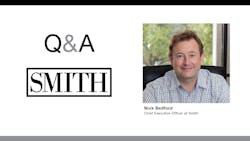
Q&A with Nick Bedford Chief Executive Officer at Smith
Key Highlights
“Supply Chain Connect has compiled sentiment and insight from a range of distribution leaders across the electronic component and semiconductor industries to deliver an informative outlook for 2026. From investment strategies to regional trends, tariff navigation and more, Distribution Outlook 2026 covers everything industry leaders are currently facing—as well as what they expect to see in the year ahead and beyond.”
How would you describe your business outlook for 2026—bullish, cautious, or uncertain—and what key factors are driving that sentiment?
As we head into 2026, we’re optimistically bullish, especially for the secondary market. The semiconductor market is forecasted to grow 7-9% next year, with DDR4 shortages likely continuing into the second quarter. Geopolitical economic divides will continue to inject uncertainty into the market in 2026, creating variables that will require constant monitoring. Secondary-market suppliers will be key partners for electronics manufacturers of all types to identify and alleviate the supply chain problems that arise from these variables.
Tariffs, the US bans on Chinese manufacturers, and continued manufacturing expansions outside of China by subcontractors and semiconductor manufacturers are all likely to contribute to and play off of the geopolitical divides, creating additional turmoil, especially early in 2026. And in the Netherlands, a final resolution for Nexperia’s internal strife has yet to surface. The effects of it will be felt well into the first quarter, extending beyond if the problems persist.
Meanwhile, data center expansion has created an environment for widespread delivery problems of server modules, hard drives, large-capacity SSDs for nearline storage, and SSDs for long-term storage. As manufacturers continue to navigate these global issues, secondary-market suppliers will be well-positioned to help them procure hard-to-find components on the open market.
Where are you focusing capital investments this year—inventory expansion, digital tools, AI automation, new facilities, or other priorities?
Given the everchanging dynamics of the electroniccomponent industry, the continued development of infrastructure, programs, and personnel will be focal points for 2026. AI initiatives will also be important tools in finetuning all of Smith's many customer-driven inventory solutions.
What do you see as the greatest opportunity for distributors this year—and the biggest risk to growth?
Data center expansions and high-performance computing are the main drivers of demand growth. The number of new companies entering the market presents opportunities for distributors to support the new arrivals when chip manufacturers cannot. Conversely, outside influences such as global inflation and the uncertainty surrounding US tariff policies will continue to hinder demand growth in consumer segments.
Which end markets (automotive, industrial, computing, defense, etc.) do you expect to lead demand in 2026?
Each end market will drive demand in specific areas based on their needs. Computing—specifically high-performance computing and data center infrastructure—will drive major demand for commodities and overall revenue growth. The networking segment will likely be the most significant driver of standard IC demand. The automotive market will continue to be the main source of demand for passive materials like ceramic capacitors, connectors, and cabling. And the aerospace and defense market is ready to spark given the continuous need for upgrades and innovation in national defense and cybersecurity technologies.
In your view, what will separate successful distributors from the rest by 2030?
Continued investments in infrastructure and personnel are necessary to keep pace with the volatile market. These are fundamental in enabling distributors to adapt to inherent industry volatility and create solutions for customers seeking to overcome it. The distributors that best balance this long-term vision against their short-term needs will continue to rise above the rest over the next half-decade.