U.S.-Canadian Trade Battle Moves to the Next Level
Download this article in PDF format.
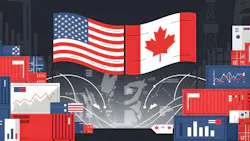
North American supply chain operators are bracing themselves for new challenges as the trade war between the U.S. and Canada drags on. Unlike some of the past levies, which were quickly repealed or reduced, this new round is showing more permanence and even deepening in certain trade areas.
The situation remains fluid, but at least for now the tariffs imposed by the U.S. government on Canadian goods were met with a tit-for-tat response on goods flowing in the opposite direction. The U.S. imposed 50% tariffs on roughly $20 billion in Canadian goods, and Canada responded with retaliatory tariffs on the same dollar amount of U.S. goods. The tariffs range from 15% to 50%, depending on the specific product category.
Things escalated last week when the U.S. banned some Canadian dairy products and motorcycles, plus most alcoholic beverages. The latest round of tariffs will go into effect later this month.
“U.S. President Donald Trump also moved to shut Canadian products out of large, long-term U.S. government contracts,” AP reports, “broadening the confrontation beyond tariffs as relations between the longtime allies deteriorate further.”
The Reciprocal Blame Game
The U.S. and Canada have continued to blame one another for the failure to reach a trade deal in August, with the former stating that the latter has engaged in unfair practices that harm domestic workers. For example, CNBC says Trump has “accused Canada of disadvantaging U.S. exports through its policies in the auto, alcohol and dairy sectors, highlighting the U.S. trade deficit in goods, and threatening to hit cars, trucks and auto parts with a 50% tariff from Jan. 1, 2027.”
The network says the tariffs apply to a “relatively small portion” of the $715.5 billion trade in goods between the countries, but says economists are concerned about an “immediate blow to small- and medium-sized businesses and of the risks to growth from further escalation.”
There are also supply chain implications to consider, with one recent report detailing airplane maker Bombardier’s tariff and trade war exposure. The company is caught in the crosshairs of the escalating war after Trump demanded that it no longer be allowed to sell aircraft in the U.S. unless it moves production here.
According to AP, Bombardier’s supply chain includes about 2,800 U.S. companies in 47 states. “Among other things, wings for its business jets are made in Texas and flight control components are produced near Los Angeles,” it reports.
“Honeywell, a major U.S. aerospace manufacturer, makes engines for Bombardier’s Challenger jets in Phoenix, and Collins Aerospace makes avionics and communications equipment in Cedar Rapids, Iowa,” AP says, adding that Bombardier has “significant operations” in Kansas. Between Bombardier’s vast supply chain and its U.S. locations, the manufacturer could face substantial negative impacts from an extended trade war between the two countries.
What’s Next?
Amid the current uncertainty, companies are assessing their cross-border sales and supply chain positioning and considering their options in a world where there’s no such thing as “fast” reshoring, onshoring or nearshoring pivots. These things take time, and when they’re implemented the companies themselves could be dealing with a very different trade environment.
Take Ford’s automotive factory in Windsor, Canada, for example. The facility produces specialized engines for some of the American manufacturer’s biggest trucks, and that production can’t just be packed up and moved elsewhere overnight.
“It’s difficult for Ford to say, ‘Ah, no problem. We’re going to import it now from Mexico,’” Ari Van Assche of HEC Montréal told CNN, “because the components made in Mexico are very different.”
About the Author
Avery Larkin
Contributing Editor
Avery Larkin is a freelance writer that covers trends in logistics, transportation and supply chain strategy. With a keen eye on emerging technologies and operational efficiencies, Larkin delivers practical insights for supply chain professionals navigating today’s evolving landscape.